
2025 Yearly Review: Building WP Umbrella for the Long Term


I really like writing these yearly reviews.
They force me to slow down and look back at what we did, but also to share with our users the full story behind our bootstrapped company.
We don’t have outside investors. The people who pay for WP Umbrella are the people we build it for. That’s why being transparent about how we operate is part of how the company works.
What a journey from our first dollars in subscriptions to a $1.3M ARR company. What was once a two-friends gamble has become a solid infrastructure, used every day by thousands of agencies to run part of their WordPress business.
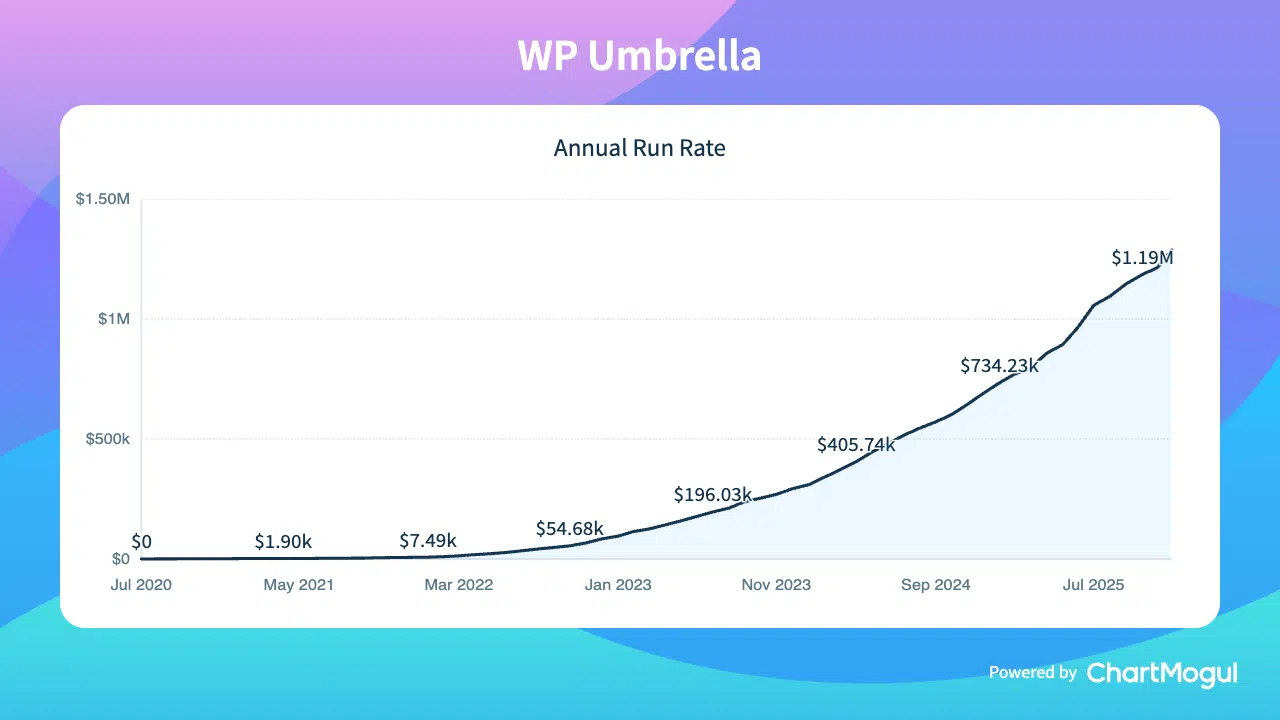
Of course, I’m not running WP Umbrella like I did last year, or the year before. I’ve added more structure.
And to be honest, I’m genuinely happy about that.
I believe my personal learning curve as an entrepreneur is following the same path as our product: more mature, more deliberate, and more reliable.
And it wasn’t easy, because all of this happened during a pretty noisy moment for WordPress.
Between ecosystem debates, aggressive competitors, and constant conversations about AI, there was a lot happening around us.
I mostly ignored it.
I kept working on the product, answering support tickets, and talking with the agencies who use WP Umbrella every day.
Most of that noise doesn’t affect how a product behaves in real life.
The boring details do. Things like reliability, edge cases, and user churn.

This yearly review is a look back at how WP Umbrella evolved in 2025, the choices we made along the way, and how we’re setting things up to keep building something solid over the long term.
2025 in numbers
Business
- Monthly recurring revenue: $110k/month (+67% year over year)
- Number of premium users: 5,196
- Churn rate: between 1% and 2%
- Agencies who used our migration service: 56
People & community
- Team: 7 people, including 3 new team members (2 in marketing, 1 in engineering)
- Community: 4 meetups and WordCamps sponsored across multiple countries
Product
- Backups created: 8,507,403
- Care reports sent: 193,946
- Updates performed: 4,619,433
- Support tickets closed: 4,985
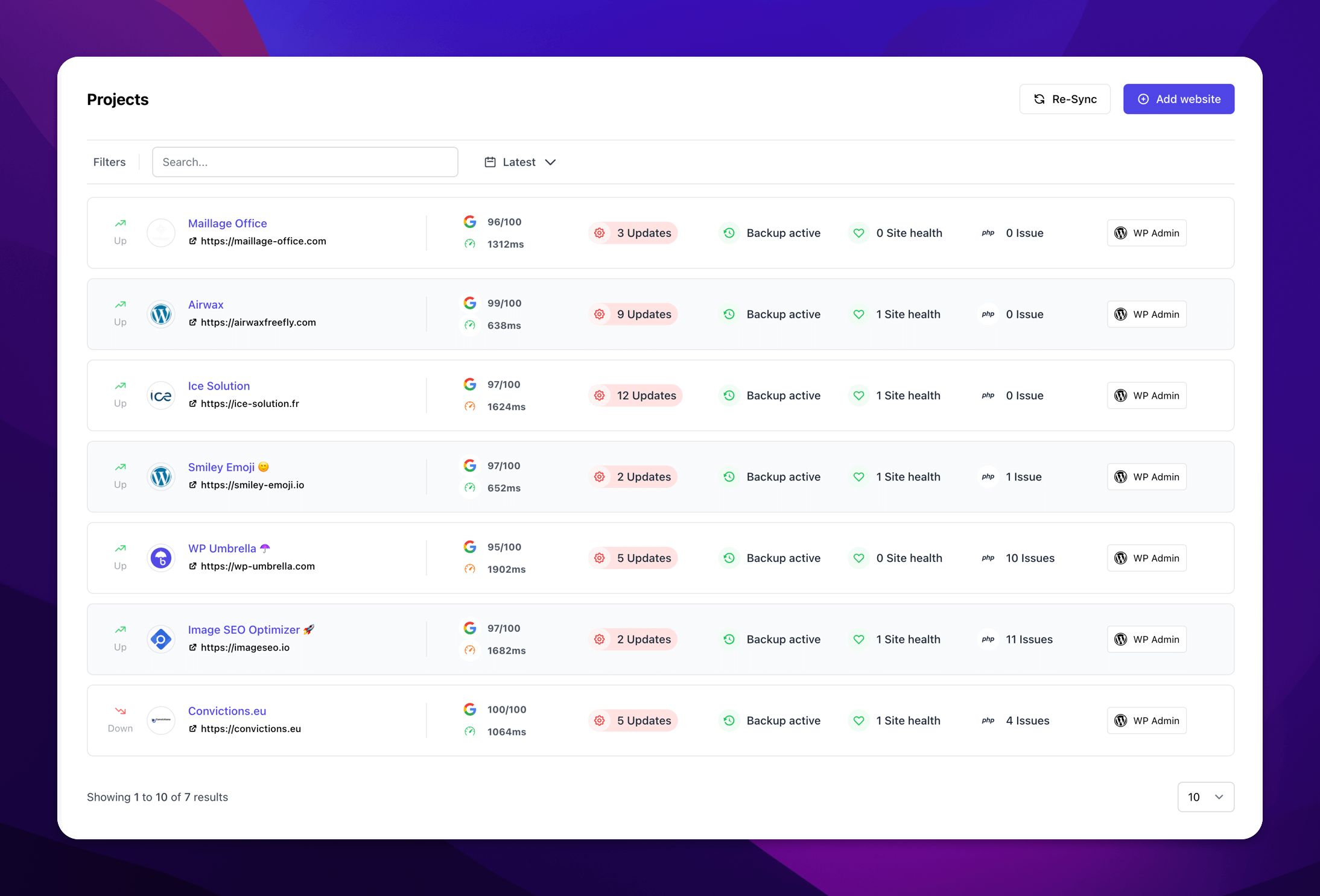
The last 20% takes most of the work
Crossing $100k in monthly recurring revenue happened during the year.

At that scale, numbers stop being clean. What looks simple on paper becomes very real when you’re responsible for large amounts of money moving every month, without having been prepared for it.
In practice, that means multiple currencies, fees, and constant adjustments. In 2025, the dollar–euro exchange rate alone cost us around €7k per month, and we paid roughly €40k in fees to Stripe over the year.
But the bigger change wasn’t financial.
WP Umbrella is no longer something agencies are trying out. It’s something they rely on every day as part of their normal workflow.
That changes priorities.
When a product is still being explored, progress looks like adding things. When it becomes infrastructure, progress is about the last 20%: the parts that don’t show up in demos, but carry most of the risk.
So we spent less time thinking about what to add next and more time making sure what was already there worked properly. Backups. Updates. Reports. Things that are invisible when they work, and very visible when they don’t.
From the outside, it may have looked like we slowed down.
Internally, we didn’t.
We were doing the harder part of the job.
Creating the most reliable backup infrastructure
That shift wasn’t only driven by growth. We already treated backups as a critical part of the product, but a concrete case involving a missing backup forced us to slow down and look at the entire system with even more rigor.
The case itself wasn’t common. But when backups are involved, edge cases aren’t exceptions. They’re the job.
We’ve been working almost exclusively on backups for nearly three years. We know the reality of this market: unreliable hosting, partial failures, and the difference between a backup that exists and one you can actually restore when things go wrong.
So we stopped and reviewed the whole system. How backups are created. How they’re verified. How they’re stored. And how they’re restored. We added integrity checks, internal monitoring, and questioned assumptions that had slowly settled over time.
This kind of work isn’t very visible, but it’s where most of the effort goes once a product is used at scale.
The result is a backup and restoration system that goes much further than what’s done in the WordPress ecosystem. It runs on infrastructure we own and operate ourselves. At that level, data control and privacy aren’t optional.
So we deliberately put most of our energy there.
(All recent improvements require version 2.21 of the WP Umbrella plugin.)
Shipping with consistency
It can sometimes feel like some features have been around for years, even when they were shipped recently. For example, our optimized reporting features were released in February.
And 2025 was clearly not only about backups.
We shipped a lot this year. But we did it with discipline: closing gaps that actually matter in day-to-day agency work, not adding features for the sake of it.
Over the year, we improved how agencies explain and deliver maintenance to their clients, how updates are reviewed and automated safely, and how much visibility they have into what happens on their sites.

This included better reporting (including work done outside WP Umbrella), virtual patching through Patchstack, clearer plugin changelogs, a full update history, mobile performance monitoring, faster bulk interfaces, and proper log pages across the platform.

All of this work wasn’t about checking boxes. It was about making sure the foundation was solid enough for what we’re preparing next, and for the agencies who rely on WP Umbrella every day.
Expanding the team and building contingency
To grow and scale, you need a team. This year also helped us clearly define our DNA, both as a company and as a group of people working together.
What we’ve learned is simple: we work best with honest people who genuinely care about what they do, and about what the company is building.

People who stay engaged beyond their task list. Not in a stressful way, but because they’re invested in the outcome. Because they take ownership.
That kind of ownership shows up in small, unglamorous places: following issues through, questioning assumptions, and caring about details that most people wouldn’t notice.
It also shows up in how we work together: flexible, autonomous, and focused. Not tied to an office, but accountable to the work and to each other, regardless of timezone or location.

This year, we added Cyrille, Manuela, and Medha to the team. Each of them took ownership of a different part of the company.
Seeing that level of ownership show up in day-to-day work is one of the things I’m most proud of as a founder.
Community and presence
We organized our annual team retreat in Annecy this year. Being together in person mattered more than the setting itself. It gave us the space to slow down, talk through open questions, and make clearer decisions about priorities and tradeoffs.
Those conversations are hard to replace with calls and messages.

We also spent time as a team at WordCamp Europe in Basel and WordCamp Poland in Krakow, and we sponsored several WordCamps in France and the Netherlands.
WordCamps are moments we really value. Not because of visibility, but because they put us in direct contact with the people who use WP Umbrella in real conditions: agencies, freelancers, and hosts dealing with the same operational problems we try to solve every day.

Those conversations lead to better questions and help keep the product grounded in how WordPress is actually used.
They’re also meaningful for the team, to receive that feedback directly from users.
Looking ahead: confidence
Each year, we pick a guiding word.
In 2023, it was focus.
In 2024, stability.
In 2025, reliability.
Most of this year was spent earning that reliability, inside the team and deep in the product. We closed important gaps and deliberately said no to some opportunities, so we could stay focused on what matters most: helping agencies maintain WordPress sites properly, without increasing risk.
For hosting companies or page builders, maintenance is often an extra revenue stream.
For us, it’s the whole job.
Because of that work, we now have a product foundation that behaves predictably in real agency workflows, and that we trust deeply.
That sets the tone for next year.
In 2026, the word will be confidence.
Confidence to not just participate in the WordPress ecosystem, but to take responsibility for the part of the market that is the hardest to serve.
Agencies managing dozens, hundreds, and sometimes thousands of WordPress sites don’t need more tools.
They need infrastructure they can commit to, standardize on, and trust under pressure.
That’s where we’re going.
We’re already working on new interfaces designed for that level of responsibility. Interfaces built to support real operations at scale, where clarity, traceability, and predictability matter more than surface-level features.
Our ambition is simple and demanding: to ship the best WordPress maintenance infrastructure for agencies who manage serious client portfolios, and to do it without losing the calm, reliability, and closeness to users that got us here.
Thank you to the team, and thank you to the thousands of agencies who trust WP Umbrella with their client sites every day.
We’re confident in the direction.
And we’re just getting started.
Aurelio