
EmDash CMS: What Agencies Should Know About Cloudflare’s CMS
Cloudflare launched EmDash, a new open-source CMS targeting WordPress. We analyze the tech, the lock-in, the security pitch, and what agencies should do

On April 1, 2026, Cloudflare released EmDash v0.1.0. MIT-licensed. TypeScript and Astro. Self-described as a “spiritual successor to WordPress.”
If you manage WordPress sites for clients, whether that’s 20 sites or 200, this landed in your feed within hours. Your first reaction was probably somewhere between a sigh and a question: what does this mean for my retainers, my care plans, and the business I’ve spent years building on WordPress?
You’ve heard “WordPress killer” before.
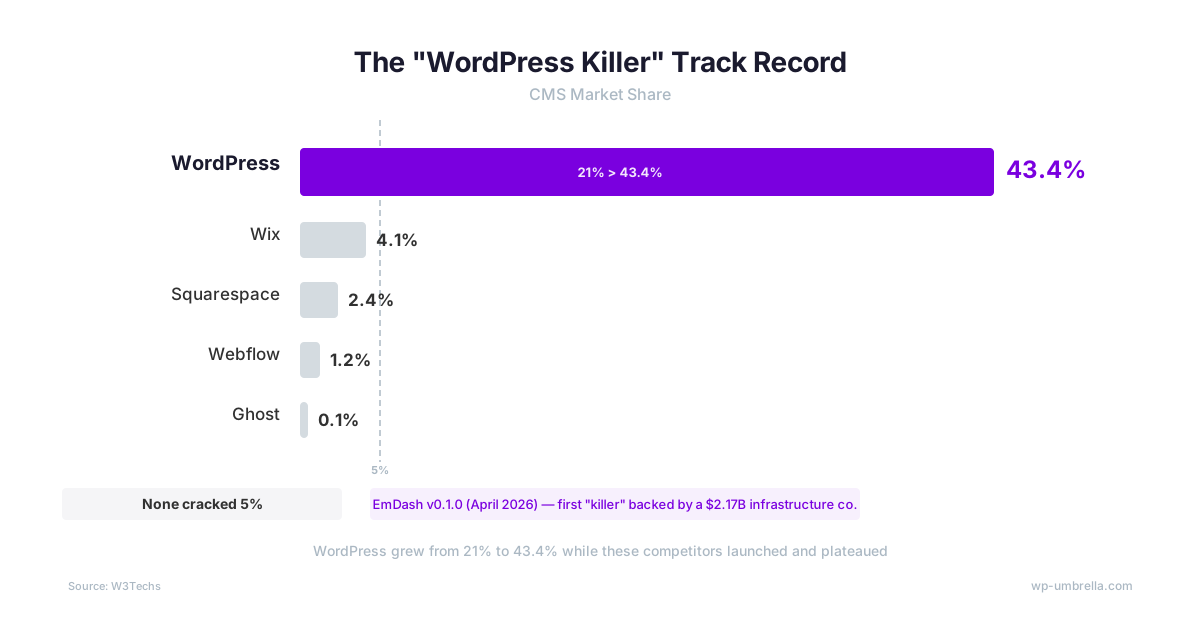
Ghost launched in 2013 with enormous hype and a Kickstarter that broke records. Ghost holds 0.1% CMS market share today.
Webflow, the darling of the design community: 1.2%. Squarespace: 2.4%. Wix, backed by billions in public-market capital: 4.1%. None cracked 5%.
During the same period those competitors launched, grew, and plateaued, WordPress went from 21% to 43.4% of all websites on the internet.
The “killer” narrative has a poor track record.
The instinct to dismiss EmDash is understandable, but Cloudflare is not a startup with seed funding and a pitch deck.
Cloudflare is a $2.17 billion-revenue infrastructure company that already sits between a significant share of the web’s traffic and its origin servers, including a large number of WordPress sites running behind its proxy.
Previous “WordPress killers” were application-layer products competing for users one at a time. Cloudflare operates at the network layer, with existing distribution, existing developer relationships, and deep capital reserves.
So, when Cloudflare enters a market, infrastructure is already in place.
That difference matters. Cloudflare’s EmDash doesn’t need to convince site owners to adopt new infrastructure. EmDash needs to convince them to use infrastructure they’re already paying for in a different way.
Cloudflare has a documented pattern: enter a market with a free or low-cost tier, reach scale through its existing customer base, then expand monetization.
Cloudflare did this with Workers.
It did it again with R2 (which eliminated egress fees to undercut S3), and EmDash follows the same playbook.
The distribution advantage is real even if the outcome is uncertain. Cloudflare doesn’t need to go door-to-door convincing agencies to try a new CMS. It already has a relationship with the developers who build and manage those sites.
Every WordPress site running behind Cloudflare’s CDN is a potential EmDash conversion target. No previous “WordPress killer” had that kind of pre-existing distribution channel into the exact audience it needed to reach.
What EmDash Actually Is (and Isn’t)
EmDash is a TypeScript-based, serverless CMS built on Astro 6.0, designed to run natively on Cloudflare’s edge infrastructure.
It is not a WordPress fork or a drop-in replacement. It is a ground-up rebuild of what a content management system looks like when designed for serverless edge computing rather than traditional LAMP-stack hosting.
The Tech Stack
Astro 6.0 ranked #1 in developer satisfaction in the most recent State of JS survey and pulls 900K weekly npm downloads.
Cloudflare acquired Astro in January 2026, giving the EmDash project direct control of its foundational framework and a built-in developer community.
EmDash runs natively on Cloudflare Workers (serverless edge compute) and uses three Cloudflare storage primitives: D1 (a SQLite-based distributed database), R2 (S3-compatible object storage), and KV (a global key-value store). No traditional server to provision, patch, or scale.
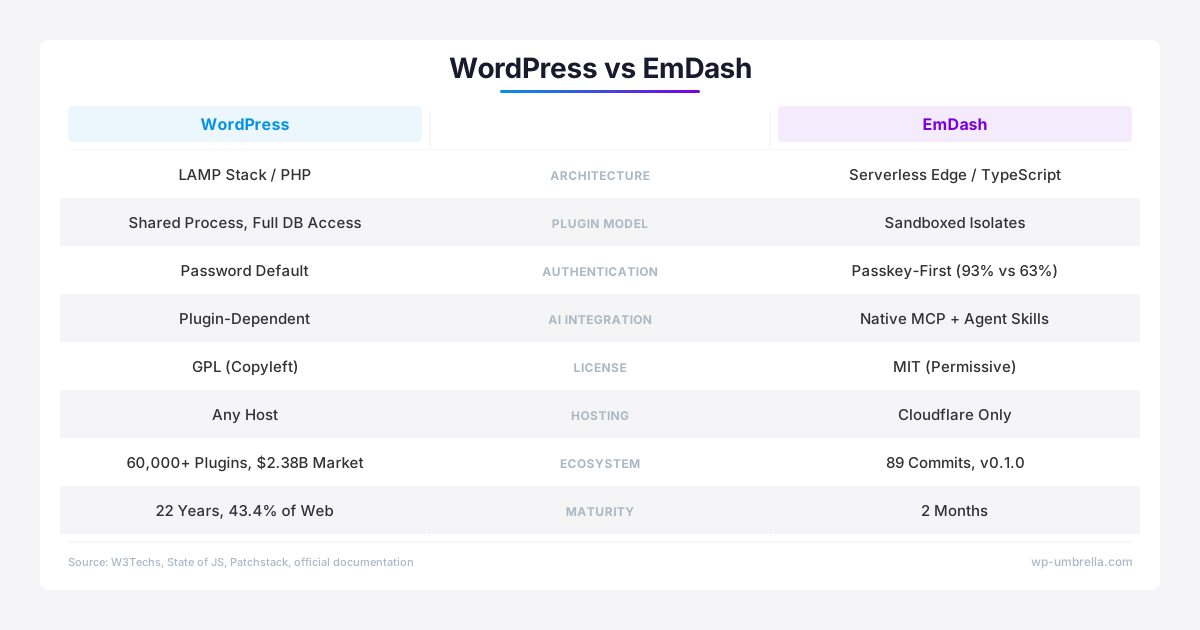
The headline feature is sandboxed plugin execution via isolates. Each plugin runs in its own environment through Cloudflare’s Dynamic Workers. A compromised or malicious plugin cannot access the database, filesystem, or memory of any other plugin or the core CMS.
WordPress uses a shared-process PHP model where every plugin runs in the same process with full access to the database and the filesystem. A vulnerable contact form plugin can become a vector for site-wide compromise.
EmDash’s isolation model eliminates that entire attack surface by design. For anyone who has dealt with a site hack traced back to a single abandoned plugin, the appeal is immediate.
Authentication is another area where EmDash leads. Passkey support is built in as the default method. Not a plugin. Not an add-on. The default.
69% of consumers now have passkeys set up. Passkeys achieve a 93% login success rate compared to 63% for traditional passwords, but WordPress still defaults to username and password, with passkey support available only through plugins.
EmDash is the first CMS designed with AI agents as first-class users rather than human-only interfaces. It ships with Agent Skills (structured documentation that teaches AI models to build themes and plugins), a CLI with JSON output for programmatic interaction, and a built-in MCP server. The entire developer experience is structured to be machine-readable from the ground up.
Joost de Valk, creator of Yoast SEO and one of the most influential figures in WordPress’s history, tested the workflow and called EmDash “the most interesting thing in content management in years.” He plans to build on it, but his recent clash with the founder of WordPress around the FAIR package initiative makes the statement less convincing.
EmDash also launched alongside the x402 payment protocol, backed by Stripe, Visa, Mastercard, Google, AWS, and Microsoft as founding members. The protocol enables AI agent micropayments at under $0.001 per transaction. Speculative today, but the founding roster suggests serious institutional commitment.
89 commits on GitHub and 6.8K stars in two months of AI-assisted development. That’s impressive speed and strong early developer interest. And a legitimate maturity concern.
Two months of AI-assisted development versus 22 years of WordPress hardening, security patching, and real-world stress-testing across hundreds of millions of installations. Speed of development and depth of battle-testing are different qualities. EmDash has the first. WordPress has the second. Agencies need both.
The Vendor Lock-In Reality
Should agencies worry about EmDash vendor lock-in?
Yes. EmDash’s best features only work on Cloudflare infrastructure, making true platform portability impossible at this stage.
EmDash’s plugin sandboxing relies on Cloudflare Workers’ isolate model. D1, R2, and KV are proprietary Cloudflare services. You cannot run D1 on AWS. You cannot migrate R2 buckets to Azure without rewriting your storage layer.
On non-Cloudflare hosting, EmDash falls back to SQLite and local filesystem storage, and the sandboxing disappears entirely. The CMS code is MIT-licensed and fully open-source. The runtime environment that enables its defining features is not.
MIT-licensed code with a proprietary runtime is a different proposition than true portability. Matt Mullenweg put it directly: EmDash “makes it hard for you to ever switch vendors.”
If a client outgrows Cloudflare’s pricing, hits a compliance requirement demanding on-premise hosting, or simply wants to consolidate vendors, the migration path strips out the sandboxing, the distributed database, and the edge-native performance. You’d be running EmDash without the features that justify choosing EmDash.
Agencies that have spent a decade building hosting-agnostic WordPress workflows should understand exactly what they’re evaluating here.
EmDash routes users into 5+ billable Cloudflare products: Workers (compute), D1 (database), R2 (storage), KV (key-value), and Workers AI. Every EmDash site is a Cloudflare customer generating recurring compute and storage revenue that scales with traffic.
Mullenweg stated that EmDash was “created to sell more Cloudflare services.” His credibility on this topic is complicated (more on that below), but the structural analysis holds regardless of the source. Cloudflare’s pattern is well documented: free entry, monetize through infrastructure.
The company reported $2.17 billion in 2025 revenue and is targeting $5 billion by 2028. Cloudflare’s largest deal exceeded $100 million, driven by Workers adoption.
EmDash fits this pattern precisely.
That’s not a criticism.
Google built Chrome to protect Search revenue. AWS built dozens of open-source tools to drive cloud adoption. Cloudflare building a CMS to grow Workers and D1 usage is the same playbook.
Agencies should understand the incentive structure and factor it into their evaluation. EmDash is a genuinely interesting product, and EmDash exists to grow Cloudflare’s platform revenue. Not philanthropy. Not cynicism. Business.
The Plugin Security Argument
The Numbers Are Real
EmDash’s strongest argument against WordPress is plugin security, and the data backs it up. Patchstack’s 2025/2026 data: 11,334 new vulnerabilities disclosed in the WordPress ecosystem, a 42% increase year over year.
91% originated in plugins, not in WordPress core. WordPress core itself is remarkably secure. The plugin ecosystem is not.
1,966 vulnerabilities were classified as high-severity (CVSS 7.0+). The weighted median time from public disclosure to mass exploitation was 5 hours.
And 46% of all disclosed vulnerabilities were unpatched at the time they were made public. No fix existed when attackers learned the vulnerability did. That 46% figure should keep agency owners up at night, and encourage the adoption of our security add-on (virtual patching, malware scanning, etc). For nearly half of newly discovered vulnerabilities, there is nothing to update to.
EmDash’s sandboxed execution reduces the blast radius of any single vulnerability to the isolated plugin environment. A compromised gallery plugin couldn’t escalate to full database access. A rogue form builder couldn’t exfiltrate the entire user table. Each plugin operates in its own sandbox, and a breach in one cannot cascade.
This is a genuine architectural advantage over WordPress’s current model.
Sandboxing vs. Operations
But sandboxing addresses the blast radius. Not the root cause.
The core problem in WordPress security isn’t that plugins share a process. The problem is a patching and maintenance gap that no architecture can fully solve. Plugins ship with vulnerabilities. Patches arrive late or never. Site owners don’t update. Nobody monitors.
The chain of failure is operational, not architectural. A sandboxed plugin with a SQL injection vulnerability still has a SQL injection vulnerability. The data within that plugin’s scope is still at risk. Smaller blast radius. Same vulnerability.
Architectural improvements and operational discipline are complementary, not competing strategies. Sandboxing is a better architecture for blast radius containment. But the WordPress sites your agency manages today cannot wait for a new architecture.
They need active management now: monitoring every plugin for known vulnerabilities, automating safe updates with rollback on failure, alerting when something goes wrong, and ensuring no site falls through the cracks.
WP Umbrella’s vulnerability monitoring provides that operational layer across every site you manage. When a vulnerability hits disclosure, you need to know about it across your entire portfolio within minutes, not hours.
With a 5-hour median exploitation window, the difference between automated monitoring and manual checking is the difference between proactive protection and incident response. The 46% of vulnerabilities that ship without patches require monitoring the threat, evaluating exposure, and applying a WAF rule or deactivating the plugin before exploitation begins. That workflow only functions at agency scale if it’s automated and centralized.
The Business Case Against Rushing
The WordPress Economy Is Enormous
That’s the estimated value of the WordPress ecosystem economy: hosting, agencies, themes, plugins, training, and consulting combined. The plugin market alone generates $2.38 billion annually.
WordPress powers 43.4% of all on the internet. Over 60,000 plugins. Tens of thousands of agencies. Hundreds of hosting companies. Millions of professional livelihoods. This is not a fragile incumbent waiting to be disrupted.
EmDash, at launch, has 89 commits on GitHub. Zero plugin marketplace. Zero theme ecosystem. Zero hosting partner network outside Cloudflare itself. Zero training programs. Zero agency tooling. Zero established freelancer community.
The gap between “promising architecture” and “viable business platform” is measured in years and billions of dollars of ecosystem investment.
The Admin Bar’s 2026 survey (622 respondents, 51 countries) reveals how structural the economics are for agencies. The average WordPress agency has 2.4 people and 12.8 years of experience. Small, experienced teams on tight margins.
The most revealing data point: agencies with 25% or more of their revenue from recurring sources (care plans, maintenance contracts, retainers) are dramatically more profitable than those without. At 0% recurring revenue, 58.3% of agencies report being unprofitable. At 25%+ recurring, fewer than one in ten do.
Care plan revenue is the financial backbone of healthy WordPress agencies.
That recurring revenue doesn’t exist in EmDash’s world. No plugin ecosystem means no maintenance economy. No update cycles to manage, no vulnerability monitoring to provide, no care plans to sell. Cloudflare handles the infrastructure. Serverless means no server management.
What does an agency bill for monthly on an EmDash site?
Run the numbers on your own business. If you manage 40 client sites at $100/month for care plans, that’s $48,000 in annual recurring revenue. At 60-80% margins, that’s $29,000-$38,000 in profit from maintenance alone.
For a 2.4-person agency, that revenue stream is often the difference between hiring a contractor and not, between investing in marketing and treading water. Now imagine telling those 40 clients you’re moving them to a platform where the concept of a care plan doesn’t exist yet, because the plugin ecosystem that generates maintenance work doesn’t exist yet.
The conversation isn’t just technical. It’s a revenue conversation, a client retention conversation, and a business model conversation all at once.
Your care plans pay salaries. Your maintenance contracts fund growth. Eliminating those revenue streams requires replacing them with something equally reliable, and that something doesn’t exist yet.
Migration Math
CMS migrations are among the most expensive, most disruptive, and most failure-prone projects an agency can undertake. Agencies that have survived one know this viscerally. Agencies that haven’t tend to underestimate the cost by an order of magnitude.
The visible costs (development hours, content migration) are only half the story. Over 50% of CMS migrations miss their stated goals on timeline, budget, feature parity, or all three.
Cost per site ranges from $10,000 to $50,000 or more, depending on complexity, integrations, content volume, and custom functionality. Timeline: 4 to 9 months per project. Retraining, workflow redesign, client communication overhead, and unforeseen technical issues typically add 15-20% in contingency spending.
For an agency managing 25 client sites, even at conservative estimates, that’s $250,000 to $1.25 million in migration costs alone. Timeline: one to three years of parallel platform operation during the transition.
Every site in migration is a site that can’t receive new features, a client whose requests get deprioritized, and a revenue stream at risk if the migration introduces regressions or downtime. A 2.4-person team with 12.8 years of WordPress-specific expertise cannot absorb that kind of platform risk on a v0.1.0 product.
Shopify, one of the most successful platform companies of the last two decades, needed over a decade to reach a meaningful app ecosystem. WordPress’s plugin directory has over 60,000 entries.
Even with AI-assisted development accelerating plugin creation, building an ecosystem of production-ready form builders, SEO platforms, e-commerce integrations, booking systems, and payment gateways requires years of iteration, bug fixes, documentation, and community trust.
Each of those plugins exists because a developer or company committed to maintaining it through WordPress version updates, hosting environment changes, and evolving security requirements. That maintenance commitment is what agencies depend on when they recommend a plugin to a client. It cannot be manufactured overnight.
Cloudflare can accelerate some of this with capital and AI tooling. Cloudflare cannot compress the battle-testing and maintenance track records that make plugins reliable enough for client work.
Why EmDash Exists Now
The Governance Vacuum
Cloudflare’s timing was not accidental. EmDash’s launch is inseparable from the governance crisis that fractured the WordPress community starting in late 2024.
A dispute between Automattic (the company behind WordPress.com) and WP Engine escalated from trademark arguments into WP Engine being blocked from WordPress.org plugin updates, the central distribution channel for WordPress plugins.
159 Automattic employees left the company via a buyout offer, and 79.2% of those departures came from the WordPress division. Community contributors were banned from WordPress.org. Trust in the governance model fractured along lines that hadn’t existed before.
The FAIR project launched under the Linux Foundation with 300 contributors, building an alternative plugin repository and governance model designed to prevent any single entity from wielding unilateral control over plugin distribution.
A jury trial is scheduled for February 2027. The outcome will have implications for WordPress.org’s legal status and governance structure that affect every agency relying on the plugin directory as infrastructure.
Cloudflare saw a window. The WordPress community was publicly questioning its own governance model, its single-point-of-failure leadership structure, and the long-term reliability of WordPress.org as neutral infrastructure.
When the entity that controls plugin distribution can unilaterally block a major hosting company’s access, every agency that depends on that directory has reason to reconsider its assumptions about platform stability.
EmDash’s MIT license (more permissive than WordPress’s GPL, with no copyleft obligations and fewer restrictions on commercial use) was a direct response to those concerns.
For plugin developers, licensing terms matter. WordPress’s GPL requires all derivative works to inherit the GPL license, creating ongoing tension in the commercial plugin market. MIT removes that friction entirely. Commercial developers can build proprietary plugins, sell under their own terms, and incorporate code without copyleft obligations.
For agencies evaluating where the ecosystem’s commercial energy will flow over the next 5 to 10 years, this is a structural factor worth monitoring. Not decisive today. But if EmDash reaches v1.0 with a viable plugin marketplace, the licensing environment could pull commercial developers in ways GPL cannot.
The Agency Decision Framework
Is EmDash a WordPress killer?
No.
Not today, and likely not in the next 3 to 5 years.
But EmDash is a credible long-term competitor that agencies should monitor, not ignore. The right response depends on your team size, client base, risk tolerance, and revenue composition.
Tier 1: Watch and wait.
Best for: most agencies managing 5 to 50+ client WordPress sites, with teams whose expertise and revenue depend on WordPress. EmDash is v0.1.0. Stay on WordPress. Invest in operational excellence: vulnerability monitoring, automated safe updates, performance optimization, client reporting. Reassess EmDash 12 to 18 months after a v1.0 release.
The highest-ROI investment right now is operational, not architectural. Reduce your mean time to respond to plugin vulnerabilities. Automate the update workflows that eat manual hours. Build reporting that proves your value at renewal time.
These investments pay off regardless of what happens with EmDash or any other CMS. And they compound: an agency with airtight security monitoring, automated safe updates, and professional client reporting is harder for clients to leave, easier for prospects to trust, and more resilient against whatever the CMS landscape looks like in 2028.
Tier 2: Experiment on internal projects.
Best for: agencies with bandwidth for R&D. Spin up a personal or internal project on EmDash. Test the AI tooling. The Agent Skills and MCP server are genuinely interesting for developer productivity.
Build a theme. Evaluate how the content editing experience compares to Gutenberg for the kind of sites your clients actually need. Form your own opinion rather than relying on secondhand accounts. But keep client work on WordPress. A personal experiment carries no client risk. A premature migration carries enormous client risk.
Tier 3: Track for future diversification.
Best for: agencies with Cloudflare-heavy clients, infrastructure products, or dedicated R&D capacity. Add EmDash to your 2027 evaluation cycle. Study sandboxed plugin execution and how the model could inform your own security practices.
Test whether the MCP server approach could be adapted for WordPress development workflows. Track x402 payment protocol adoption. If autonomous AI agent transactions become standard, WordPress will need equivalent infrastructure, and agencies who understand the pattern early will be positioned to build it.
The strategic value here isn’t adopting EmDash. It’s understanding the architectural patterns that will eventually arrive in WordPress through plugins, hosting-layer innovations, or core updates. Agencies that studied headless WordPress early were the ones who won enterprise contracts when the market shifted. The same dynamic applies here.
WordPress sentiment data provides context across all three tiers. Overall satisfaction sits at 63.3%, down from 68%. That decline is real. But agencies that adopted AI-positive workflows grew 58.5%, suggesting the path forward is operational modernization, not platform abandonment.
The answer is not rebuilding from scratch. The answer is managing the existing stack with the operational rigor the platform demands.
If your agency manages WordPress sites at scale, WP Umbrella is built for exactly your situation: the operational infrastructure that makes WordPress care plans reliable, professional, and scalable.
Your WordPress Sites Need Management Today
11,334 vulnerabilities. 5-hour exploitation windows. 46% unpatched at disclosure. Whether EmDash succeeds or fails over the next five years, the Patchstack data has already proven one thing: WordPress sites without active management are operating on borrowed time.
The question isn’t whether to manage your WordPress portfolio. The question is whether you’re doing it with the right infrastructure.
WP Umbrella maps directly to the problems EmDash’s architecture highlights, with solutions available today. Vulnerability monitoring across every site in one dashboard, before the 5-hour window closes.
Safe updates with visual regression and automatic rollback so you stop choosing between “update and pray” and “never update.”
Multiple sites management for 10, 50, or 200+ sites with bulk actions, uptime checks, and performance monitoring. White-label client reports that prove your value and justify your care plans on autopilot.
The EmDash conversation is about where the CMS market might go in 3 to 5 years. Your WordPress sites are generating revenue for your agency this morning. Manage what you have, better.
Start your free trial. No credit card required.
The Bottom Line
EmDash is a serious project backed by serious infrastructure. Sandboxed plugins, passkey-first authentication, AI-native developer tooling: these are real innovations from a company with the resources to sustain a long bet. Credit where it’s earned.
But attention is not action. WordPress powers 43.4% of the web, supports a $596.7 billion economy, and your clients’ sites are running on it right now, generating the revenue that keeps your agency alive.
The agencies that thrive in 2026 won’t be the ones who chased a v0.1.0 platform.
They’ll be the ones who managed their WordPress infrastructure with discipline while everyone else was distracted by the next headline.
Watch EmDash. Respect the engineering. And manage what’s in front of you.